#10 Michael Haneke & VALIE EXPORT on Power, Violence and Intimacy in German-Austrian Cinema
How do you introduce two of Austria’s most internationally successful filmmakers and artists to an international audience and how do you grapple with them yourself? That was our starting point for this episode, in which we take on Michael Haneke’s The White Ribbon (2009) and VALIE EXPORT’s The Practice of Love (1985). Both films also connect to a central thread of Season IV and our research project ReFraming Masculinities: how cinema represents masculinity, here as authoritarian fatherhood and the „soldier male“ in Haneke’s village, and as networks of male power in EXPORT’s political thriller.
At first glance, the two films could hardly be more different. Made more than twenty years apart and rooted in very different cinematic traditions, they nevertheless ask surprisingly similar questions: Who has power? How is violence produced and passed on? What happens when political and social structures enter private life, the family, the relationship, the body? And how can films so deeply rooted in a specific Austrian or German context become internationally relevant?
Haneke became one of the central figures of international auteur and arthouse cinema, while VALIE EXPORT built her reputation across feminist art, performance, photography, film and media art, two very different paths to international recognition.
#10 Films
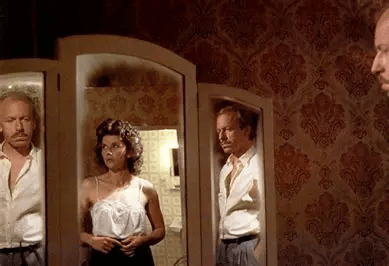
The White Ribbon [Das weiße Band – Eine deutsche Kindergeschichte], Michael Haneke, Germany/Austria/France/Italy, 2009
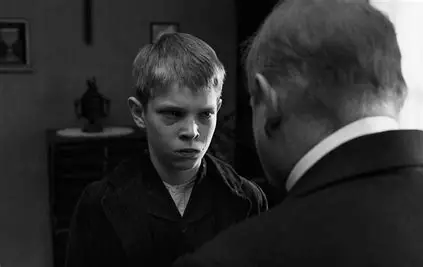
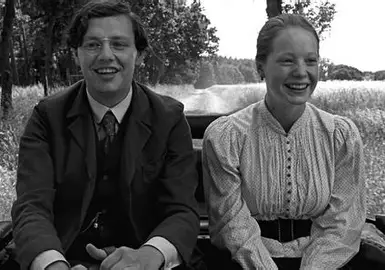
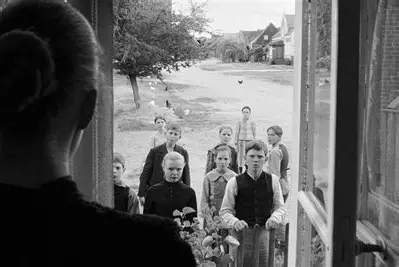
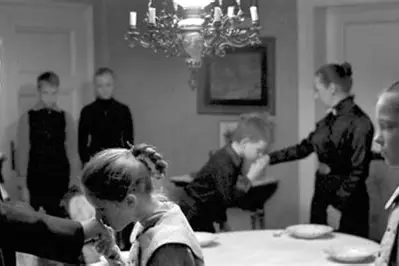
In a Protestant village in northern Germany on the eve of the First World War, a series of unexplained acts of violence and cruelty unsettles the community. Rather than solving a mystery, Haneke turns his gaze on the structures behind it: authoritarian fathers, religious morality, rigid hierarchies and harsh education. We talk about violence as something ordinary rather than exceptional, about children as both victims and possible perpetrators, about the white ribbon as an increasingly ironic symbol of purity, and about everything Haneke chooses not to show us. Palme d’Or, Cannes 2009.
For our reading of the film, we draw heavily on Klaus Theweleit’s Male Fantasies [Männerphantasien]. Theweleit traces how the „soldier male“ of the Freikorps and early fascism was formed through drill, discipline, shame and the suppression of desire, a body armoured against everything soft, feminine and uncontrollable. Watching The White Ribbon through this lens, the village’s children appear as the generation that would come of age in the trenches and the Freikorps: not born violent, but shaped into it. Haneke does not draw this line explicitly but the film shows the conditions under which such authoritarian, armoured masculinities can emerge.
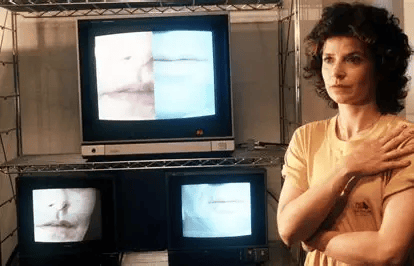
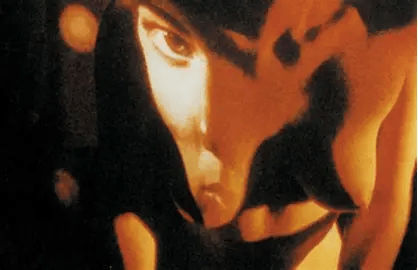
The Practice of Love [Die Praxis der Liebe], VALIE EXPORT, Austria/West Germany, 1985
Journalist Judith investigates a suspicious death and is drawn into a network of political and economic interests, arms trafficking and male power, a world to which her lover Alphons seems increasingly connected. Moving between political thriller, relationship drama and experimental film, EXPORT shows how intimacy, sexuality and the female body are entangled with surveillance, media and power. We ask what it means to „practise“ love, who gets to look and who is looked at, and what happens when a performance and media artist turns to narrative cinema. World premiere at the Berlinale 1985.
Two films, two forms of uncertainty: in The White Ribbon, we do not know what happened. In The Practice of Love, nobody knows who knows what. In both, information becomes a source of power and neither film allows its audience to remain comfortable or passive.
#10 Key questions
Is violence individual or institutional and can a society teach violence without ever explicitly teaching it?
Why are children in The White Ribbon both victims and perpetrators?
How is the „soldier male“ produced and what does Theweleit help us see in Haneke’s village?
Can love ever be separated from the power structures surrounding it?
Who controls the body, and who controls information?
Does a film need to become culturally neutral to travel or is its specificity exactly what makes it speak to audiences elsewhere?
How do the systems around us shape the way we live, love and treat other people?

#10 Film credits
The White Ribbon [Das weiße Band – Eine deutsche Kindergeschichte]
Germany/Austria/France/Italy 2009, 144 min
Director/ Writer: Michael Haneke, Cinematography: Christian Berger, Editing: Monika Willi, Production: X Filme Creative Pool (Stefan Arndt), Wega Film (Veit Heiduschka, Michael Katz), Les Films du Losange (Margaret Ménégoz), Lucky Red (Andrea Occhipinti), Distribution: X Verleih (Germany); World Sales: Les Films du Losange
The Practice of Love [Die Praxis der Liebe]
Austria/West Germany 1985, 90 min
Director, Writer: VALIE EXPORT, Cinematography: Jörg Schmidt-Reitwein, Editing: Juno Sylva Englander, Production: VALIE EXPORT Filmproduktion, Königsmark & Wullenweber Filmproduktion (Hamburg), in co-production with ZDF and ORF, Distribution: sixpackfilm
#10 Filmographies (selection):
Michael Haneke (*1942, Munich; grew up in Wiener Neustadt), writer and director
Funny Games (1997) – Writer/Director: Michael Haneke; DoP: Jürgen Jürges; Editing: Andreas Prochaska
The Piano Teacher [Die Klavierspielerin] (2001) – Writer/Director: Michael Haneke (based on the novel by Elfriede Jelinek); DoP: Christian Berger; Editing: Monika Willi; Grand Prix, Cannes
Hidden [Caché] (2005) – Writer/Director: Michael Haneke; DoP: Christian Berger; Editing: Michael Hudecek, Nadine Muse; Best Director, Cannes
The White Ribbon [Das weiße Band – Eine deutsche Kindergeschichte] (2009) – Writer/Director: Michael Haneke; DoP: Christian Berger; Editing: Monika Willi; Palme d’Or, Cannes
Amour [Liebe] (2012) – Writer/Director: Michael Haneke; DoP: Darius Khondji; Editing: Monika Willi, Nadine Muse; Palme d’Or, Cannes; Academy Award for Best Foreign Language Film
VALIE EXPORT (*1940, Linz), media and performance artist, filmmaker
TAPP und TASTKINO [Touch Cinema] (1968) – concept and performance (expanded cinema action, with Peter Weibel)
Action Pants: Genital Panic [Aktionshose: Genitalpanik] (1969) – concept and performance
Invisible Adversaries [Unsichtbare Gegner] (1977) – Writer/Director: VALIE EXPORT (co-writer: Peter Weibel); DoP: Wolfgang Simon; Editing: Herbert Baumgartner, Juno Sylva Englander, VALIE EXPORT
Human Women [Menschenfrauen] (1980) – Writer/Director: VALIE EXPORT (co-writer: Peter Weibel); DoP: Wolfgang Dickmann, Karl Kases; Editing: Tina Frese, Friedl Mayer
The Practice of Love [Die Praxis der Liebe] (1985) – Writer/Director/Producer: VALIE EXPORT; DoP: Jörg Schmidt-Reitwein; Editing: Juno Sylva Englander
#10 Further reading
Kondor, Eszter / Loebenstein, Michael / Müller, Katharina (eds.) (2025): How to Do Things with VALIE EXPORT. Vienna: Österreichisches Filmmuseum / Leipzig: Spector Books. (German edition ISBN 978-3-95905-890-2; English edition ISBN 978-3-95905-898-8)
Theweleit, Klaus (1977/78): Männerphantasien. 2 vols. Frankfurt am Main: Verlag Roter Stern. (English: Male Fantasies, 2 vols., Minneapolis: University of Minnesota Press, 1987/1989)
Grundmann, Roy (ed.) (2010): A Companion to Michael Haneke. Malden/Oxford: Wiley-Blackwell.
Wheatley, Catherine (2009): Michael Haneke’s Cinema: The Ethic of the Image. New York/Oxford: Berghahn Books.
Assheuer, Thomas (2008): Nahaufnahme Michael Haneke. Gespräche mit Thomas Assheuer. Berlin: Alexander Verlag.
Cieutat, Michel / Rouyer, Philippe (2013): Haneke über Haneke. Gespräche mit Michel Cieutat und Philippe Rouyer. Berlin: Alexander Verlag.
van der Pol, Gerwin (2018): „Punishment and Crime: The Reverse Order of Causality in The White Ribbon.“ In: Journal for Religion, Film and Media 4 (1), pp. 47–60.
Müller, Katharina (2014): Haneke. Keine Biografie. Bielefeld: transcript. (ISBN 978-3-8376-2838-8)

